

A business website is often the first interaction a customer has with a brand. Within just a few seconds, visitors decide whether to stay, explore, or leave. In today’s competitive digital environment, website speed and user experience are no longer optional—they directly influence customer trust, search engine rankings, and business growth.
Google introduced Core Web Vitals to measure how users experience a website in real-world conditions. These metrics go beyond aesthetics and evaluate loading speed, responsiveness, and visual stability. A slow or poorly optimized website not only frustrates users but also reduces conversions and negatively impacts search rankings.
For businesses investing in digital marketing and SEO, optimizing Core Web Vitals has become essential. At Arjun Web Solutions, we help organizations improve website performance using modern development practices, advanced optimization techniques, and continuous performance monitoring.
What Are Core Web Vitals?
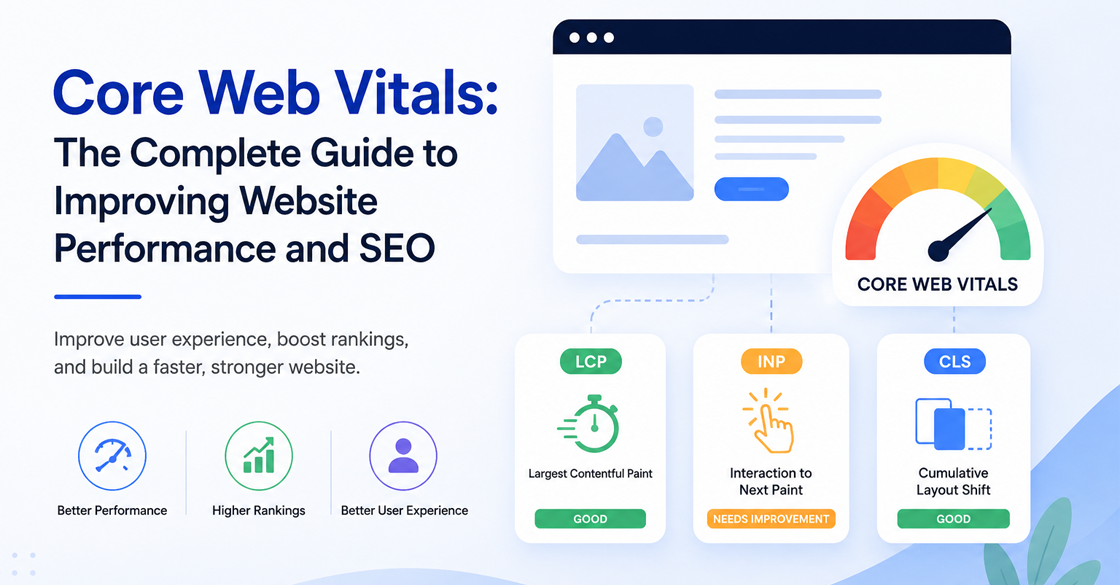
Core Web Vitals are Google’s user experience metrics designed to evaluate how visitors interact with a webpage. These metrics measure the quality of a website’s performance rather than simply its appearance.
The three primary Core Web Vitals are:
Largest Contentful Paint (LCP)
LCP measures how quickly the largest visible element on a webpage loads. This could be a hero image, banner, or large block of text.
Google recommends that LCP should occur within 2.5 seconds for an optimal user experience.
A slow LCP often results from:
- Large image files
- Slow hosting
- Render-blocking JavaScript
- Poor server response time
- Excessive third-party scripts
Improving LCP helps visitors access important content faster, reducing bounce rates and improving engagement.
Interaction to Next Paint (INP)
INP measures how quickly a website responds to user interactions such as clicks, taps, or keyboard input.
A responsive website feels smooth and reliable. Delays can frustrate users, especially during form submissions, navigation, or online purchases.
Common causes of poor INP include:
- Heavy JavaScript execution
- Complex animations
- Slow browser processing
- Inefficient code
Optimizing JavaScript and reducing unnecessary processing significantly improves responsiveness.
Cumulative Layout Shift (CLS)
CLS measures visual stability.
Have you ever tried clicking a button only to have the page suddenly shift because an image or advertisement loaded late? That’s a layout shift.
Google recommends maintaining a CLS score below 0.1.
Poor CLS is often caused by:
- Images without dimensions
- Dynamic advertisements
- Embedded videos
- Late-loading fonts
- Content inserted after page load
Stable layouts create a better browsing experience and increase user confidence.
Why Core Web Vitals Matter for SEO
Google considers page experience as part of its ranking algorithm. While content quality remains the most important ranking factor, websites with better user experiences often perform better in search results.
Benefits of optimized Core Web Vitals include:
- Higher search engine rankings
- Better user engagement
- Lower bounce rates
- Increased conversions
- Improved mobile performance
- Enhanced brand credibility
A fast website encourages visitors to explore more pages, spend more time on your site, and complete desired actions.
How Website Speed Affects Business Growth
Website performance directly impacts revenue.
Studies consistently show that even a one-second delay in page loading can reduce conversions, increase abandonment rates, and lower customer satisfaction.
For businesses, this means:
- Lost sales opportunities
- Reduced lead generation
- Lower advertising ROI
- Poor customer retention
Speed optimization is not just a technical improvement—it is a business strategy.
Common Performance Issues
Many websites experience poor Core Web Vitals due to avoidable mistakes.
These include:
- Uncompressed images
- Outdated themes or plugins
- Excessive JavaScript libraries
- Too many third-party tracking scripts
- Slow shared hosting
- Poor caching configuration
- Unoptimized CSS
- Large video backgrounds
Regular technical audits help identify these issues before they affect user experience.
Best Practices for Core Web Vitals Optimization
Optimize Images
Large image files are one of the biggest reasons websites load slowly.
Businesses should:
- Use next-generation formats like WebP
- Compress images without reducing quality
- Implement lazy loading
- Resize images appropriately
Improve Hosting Infrastructure
Website speed depends heavily on hosting performance.
Modern cloud hosting, CDN integration, SSD storage, and scalable infrastructure provide significant performance improvements.
Minimize JavaScript
Heavy JavaScript slows down website interaction.
Developers should:
- Remove unused code
- Delay non-essential scripts
- Minify JavaScript files
- Split large bundles
Implement Browser Caching
Caching stores website resources on visitors’ devices, reducing load times during repeat visits.
Effective caching improves both speed and user experience.
Reduce Third-Party Scripts
Analytics tools, chat widgets, advertising platforms, and social media integrations often increase loading times.
Only essential scripts should be included.
Use a Content Delivery Network (CDN)
A CDN distributes website files across multiple global servers.
Visitors automatically receive content from the nearest server, improving speed regardless of location.
Measuring Core Web Vitals
Several professional tools help evaluate website performance.
Popular options include:
- Google PageSpeed Insights
- Google Search Console
- Lighthouse
- Chrome DevTools
- GTmetrix
Regular monitoring helps businesses identify new optimization opportunities.
Core Web Vitals and Mobile Users
More than half of global web traffic comes from mobile devices.
Mobile users expect websites to load quickly, respond instantly, and remain visually stable.
Responsive design, optimized images, lightweight code, and efficient mobile layouts are essential for delivering excellent mobile experiences.
Businesses ignoring mobile performance risk losing both customers and search visibility.
Future Trends in Website Performance
Website optimization continues to evolve.
Emerging trends include:
- AI-driven performance optimization
- Edge computing
- Server-side rendering
- Static site generation
- Predictive resource loading
- HTTP/3 adoption
- Smarter caching algorithms
Organizations that embrace these technologies will deliver faster, more reliable digital experiences.
Why Choose Arjun Web Solutions?
At Arjun Web Solutions, we understand that website performance is critical for online success.
Our team provides:
- Core Web Vitals optimization
- Technical SEO audits
- Website speed optimization
- Custom web development
- Performance-focused redesigns
- Cloud hosting consultation
- Website maintenance
- Continuous performance monitoring
We build websites that are not only visually appealing but also fast, secure, and optimized for search engines.
Conclusion
Core Web Vitals have become one of the most important aspects of modern website development. Businesses that invest in performance optimization benefit from improved SEO rankings, higher customer satisfaction, increased conversions, and stronger online visibility.
Rather than treating website speed as a one-time project, organizations should adopt continuous optimization practices to maintain peak performance.
If you’re looking to improve your website’s speed, user experience, and search engine performance, Arjun Web Solutions can help. Our experienced team delivers advanced web development and optimization solutions that prepare your business for long-term digital success.